2026 summer will be more hotter than regular summer?
Published by: Bhuvan , Published on: 11-03-2026 , LastUpdated On: 11-03-2026
: 64 : 2 : 0
The summer season of 2026 could be hotter than normal for most of the Himalayan region, northeastern states and some parts of the Western Ghats region, according to data from the India Meteorological Department’s (IMD) seasonal outlook for March-April-May. These are also the three major regions with mountains and hills in the country.
The maximum temperatures in the period of March-April-May could likely be above normal over most parts of the country, except for some parts of northwest and central India, as per IMD. There wouldn’t be much respite during the nights as minimum or night-time temperatures could also be above normal, except for some parts of south peninsular India and isolated pockets elsewhere.
The weather agency has also generated an alert for above-normal number of heatwave days over most parts of east, east-central, many parts of southeastern peninsula and some parts of northwest and west central India during March to May.
For the month of March, IMD predicted day-time temperatures to be normal or below normal for many parts of the country, except the northeastern region, some parts of eastern India and the Western Himalayan region. Most of the regions across the country, except some parts of northwest, southern peninsula and eastern coast, could also experience heightened night-time temperatures.
How EL Nino and La Nina will affect the temperature:
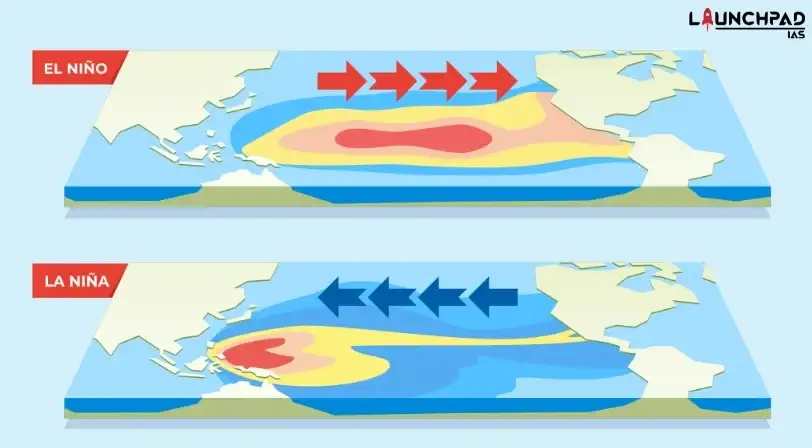
EL Nino and La Nina are climate patterns in the Pacific Ocean that can affect weatherworldwide. During normal conditions in the Pacific Ocean, trade winds blow west along the equator, taking warm water from South America towards Asia. To replace the warm water, Cold water rises from the depths of the Ocean – in a process called upwelling. EL Nino and LA Nina are two opposing climate patterns that break these Normal conditions. It is called the EL- Nino South Oscillation (ENSO Cycle) EL Nino and La Nina events two to seven years, on average but they do not occur on a regular schedule.
EL Nino :
- EL Nino is Spanish and means “Little boy”
- It is a climate pattern that describes the usual warning of surface waters in the Eastern Tropical Pacific Ocean.
- It is the “warm phase” of a layer phenomenon called the EL – Nino Oscillation (ENSO)
LA Nina :
- La Nina means “Little Girl” in Spanish.
- It is a pattern that describes the “usual cooling” of the tropical Eastern Pacific.
- La Nina may last between one and three years, which usually lasts no more than a year.
- It represents Below-Average sea surface temperatures across the East-Central equatorial Pacific.
- It is also associated with rainier-than-normal conditions over South Eastern Africa and Northern Brazil.
This would mean that the mountainous and hilly areas could also suffer from early heat. The experience of heightened temperatures would be further enhanced by the lack of rainfall in large parts of the western Himalayan region and northeast India.
The increase in heat during the summer season after a predominantly dry winter season could also lead to a further increase in dryness, drought-like conditions and wildfires, especially in the hills and mountains. Some of the hilly regions have already seen uncharacteristic wildfires in January and February, especially at higher altitudes.
The chance of maximum temperatures being above normal is the highest for almost the entire state of Jammu & Kashmir, most of the mountainous regions of Himachal Pradesh and the highest regions of Uttarakhand. These regions could most likely experience above-normal minimum temperatures.
The probabilities of heightened day-time temperatures is also highest for most of northeast India, except for most of Tripura, some parts of Assam and isolated parts of Nagaland and Arunachal Pradesh. In the Western Ghats, the chance is highest for coastal Karnataka, some parts of coastal Maharashtra and isolated parts of central Kerala.
The uncharacteristic heat in the hills and mountains would force populations unaccustomed to hot conditions to adapt to them. IMD also predicted above-normal heatwave days in some parts of Himachal Pradesh, Jammu & Kashmir, Uttarakhand and the Western Ghats of Maharashtra.
“During the March–April–May season, the increased likelihood of heatwave conditions may pose significant risks to public health, water resources, power demand and essential services, particularly affecting vulnerable populations such as the elderly, children, outdoor workers and individuals with pre-existing medical conditions,” said IMD in a press release.
"Elevated temperatures can lead to heat-related illnesses and additional stress on infrastructure and resource management systems. Accordingly, State authorities and district administrations are advised to ensure timely preparedness, including operational readiness of cooling shelters, adequate drinking water supply and strengthened health surveillance,” the weather agency added.
: 2 : 0